
Thornback Ray
Raja clavata
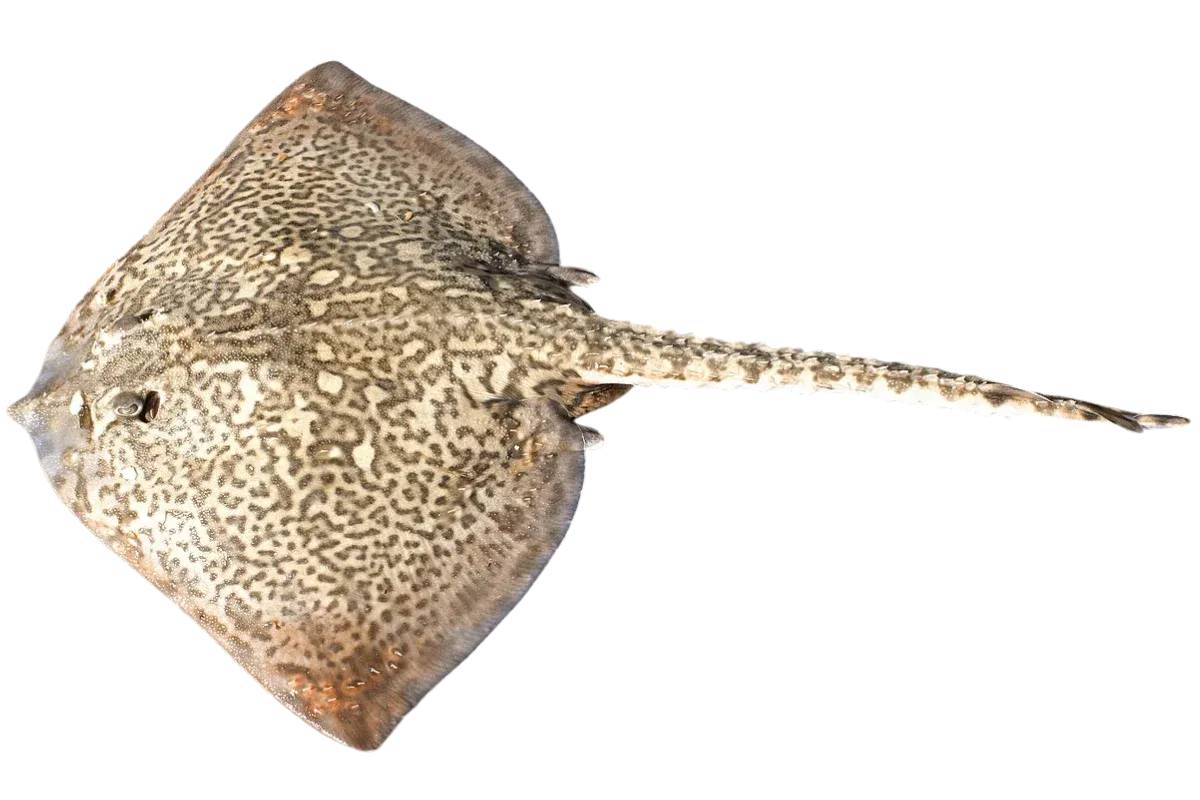
The Thornback Ray, which is also widely known as the Thornback Skate or the Roker, is the most common and commercial species of ray in regional waters. It belongs to the Rajidae family and is often confused with the stingray, but there is a fundamental difference in safety. The Thornback Ray is harmless because it does not possess a venomous stinger on the tail. Instead, its defence is based on a series of hard, sharp, and curved thorns, like cat claws or clubs, that cover its back and tail, making the skin extremely rough.
The body is shaped like a rhombus with wide pectoral fins. The colour of the back varies with the seabed, from brown and grey to olive, and is covered in irregular dark and light spots that provide perfect camouflage. The tail is thick and fleshy with two small fins at the tip, in contrast to the thin tail like a whip found on the stingray.
This is a benthic species that inhabits a wide variety of seabed habitats. It is encountered on sandy, muddy, and gravelly bottoms at depths ranging from 10 to 300 metres, though it is more common between 10 and 60 metres. It often remains half-buried in the sand during the day and hunts primarily at night.
The animal is a carnivorous fish with strong jaws. It feeds mainly on benthic organisms such as crabs, shrimp, and other crustaceans, which it crushes easily. It also consumes small fish that live on the bottom, such as gobies, sand eels, and dragonets, as well as worms.
The Thornback Ray is an oviparous species, in contrast to the stingray, which gives birth to live young. The female lays eggs, which are protected inside characteristic, hard, black, and rectangular capsules with four horns at the corners. These capsules, which are known as mermaid purses, are often washed up empty on beaches after the young have hatched. Reproduction takes place primarily in the spring and summer.
It represents an important commercial catch in the Mediterranean. It is caught mainly with bottom trawls, set nets, and longlines. In the market, its wings or pectoral fins are primarily sold after the tough, thorned skin has been removed. The meat is white and boneless, with only soft cartilage, and it has a distinctive stringy texture and a very delicious flavour that resembles crab or lobster. It is ideal for frying and is often accompanied by a garlic dip.
The International Union for Conservation of Nature classifies the Thornback Ray as Near Threatened globally due to population declines from overfishing. Scientific studies have shown that it is a slow-growing species that reaches sexual maturity at a relatively old age of about 7 to 8 years, which makes it vulnerable. Furthermore, research showed that females migrate to shallower waters during the breeding season to deposit their eggs.
| Country | Local Name |
|---|---|
 Italy
Italy
|
Razza chiodata |
 Spain
Spain
|
Raya de clavos |
 France
|
Raie bouclée |
 Turkey
|
Vatoz |
 Malta
Malta
|
Rajja tal-imsiemer |
| 🌍 North Africa (Tunisia/Libya/Egypt) | Raie or Samak al vatos |
| 🌊 Adriatic Coast (Croatia/Slovenia) | Raža kamenjarka |
 Greece
|
Ragia or Vatos or Akanthoragia |